> ## Documentation Index
> Fetch the complete documentation index at: https://docs.runtm.com/llms.txt
> Use this file to discover all available pages before exploring further.
# 1. Define the job
> Create a roster agent with a name, description, system instructions, default template and coding agent, and write an objective that states input, output and boundary. Read before `runtm-api agents create` or the Agents > New Agent dialog.
## Outcome
A roster agent exists with a one-line description that states its job and system instructions that say how to do it and what never to do. Every trigger you connect later inherits this profile.
## Decide
**What is the input, the output, and the boundary?** An objective that names all three grades well and stays out of trouble.
| | Bad | Good |
| --------- | ---------------------------------- | ----------------------------------------------------------------------------------------------------------------------------------------------- |
| Objective | "Help with payments." | "Given a Zendesk ticket about a charge, reconstruct the payment timeline from Stripe and the ledger and draft a customer reply. Never send it." |
| Why | Nothing to grade, nothing to stop. | Input (a ticket), output (a draft with evidence), boundary (never send). The success criteria in step 2 write themselves. |
**What does the agent never do?** Money movement, status changes, customer-facing sends, account blocks. Write these as flat prohibitions in the system instructions now. Enforce them with guardrails in step 6, after the agent has proven in step 5 that it can do the job with read-only access. Instructions alone are advice; guardrails are enforcement; the order matters because a rule written before the first run is a guess.
**Which coding agent runs it?** The coding agent (harness) is the program that executes the run inside the sandbox. Templates and sessions accept five: `claude-code`, `codex`, `opencode`, `cline` and `github-copilot`. Cursor, Devin and Gemini exist as interactive terminal harnesses for hands-on sessions and need your own provider key; they have no prompt API, so triggers cannot drive them.
| Harness | Driven by triggers (prompt API) | Streaming, plan mode, todos | Attachments | Platform credits | Notes |
| ---------------- | ------------------------------- | --------------------------- | ----------- | ---------------- | ------------------------------------------------------------------------------------------------------------------------------------------ |
| `claude-code` | yes | yes | yes | yes | Default. Only harness with message editing (rewind and branch). Models: `sonnet`, `opus`, `haiku`, `fable`; free tier is sonnet and haiku. |
| `codex` | yes | yes | yes | no | GPT models (`gpt-5.4`, `gpt-5.5`, `gpt-5.6-sol`, `gpt-6-astra`). |
| `opencode` | yes | yes | yes | no | Provider-qualified model ids such as `anthropic/claude-sonnet-5` or `moonshot/kimi-k3`. |
| `cline` | yes | no | no | no | Anthropic models only. |
| `github-copilot` | no | no | no | no | Terminal only; `gh auth login` with `GH_TOKEN`. |
Pick `claude-code` unless you have a reason not to; every worked example in Guides uses it.
**Which template does it run on?** The template is where tools, MCP servers, secrets and skills live. If you have not built one yet, create a blank one now and fill it in during [Give it tools](/build/give-it-tools). An agent without a default template launches on a bare sandbox and has no tools.
## Do it
The dialog walks through **Profile**, **Instructions**, **Triggers**. Its own description says it: "Define the agent once, then connect it to Slack, Linear, and GitHub."
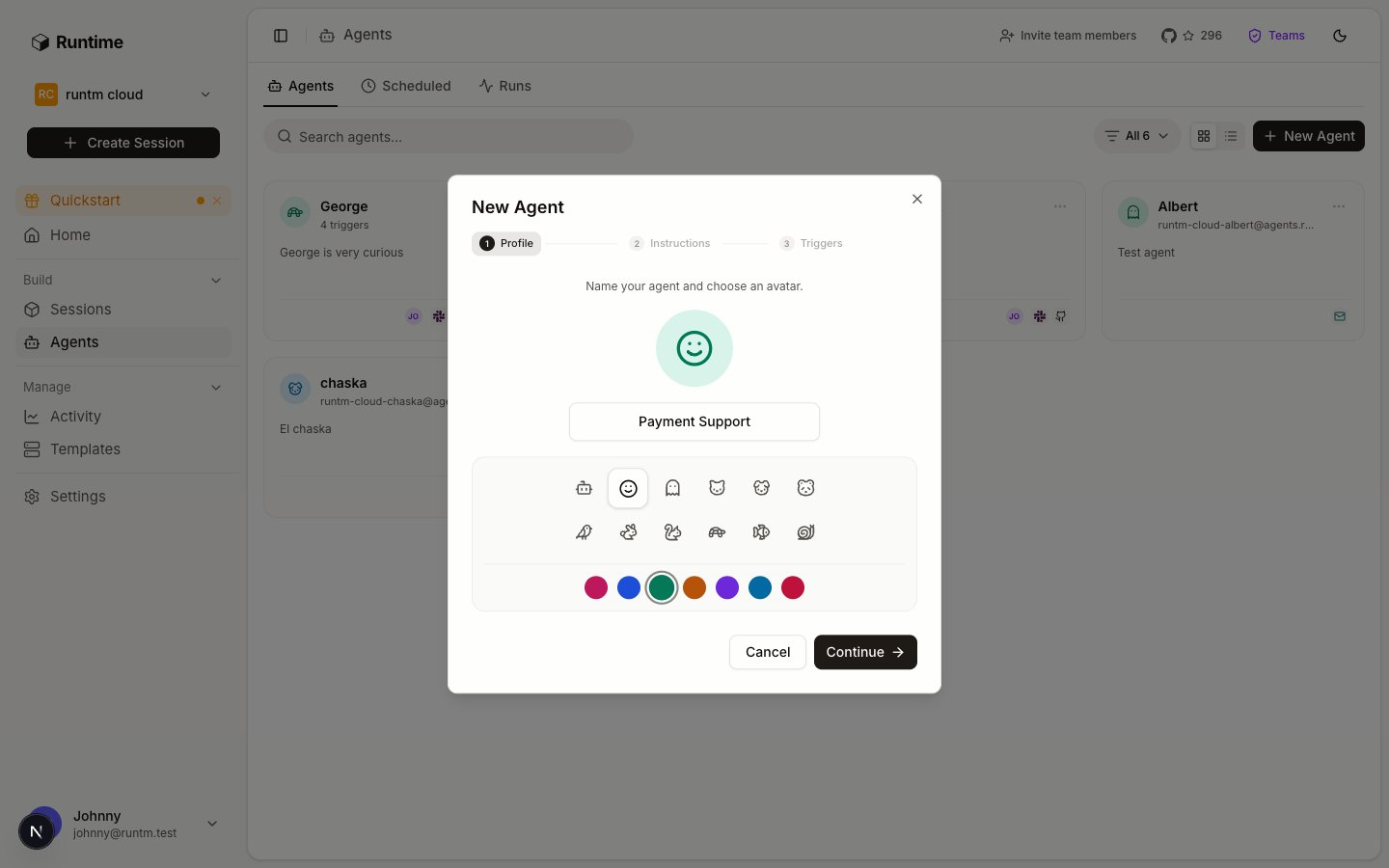 **Agent name** is at most 34 characters and is what people will type after `@` in Slack. Pick the avatar; when a Slack app is connected later, its icon is set from this.
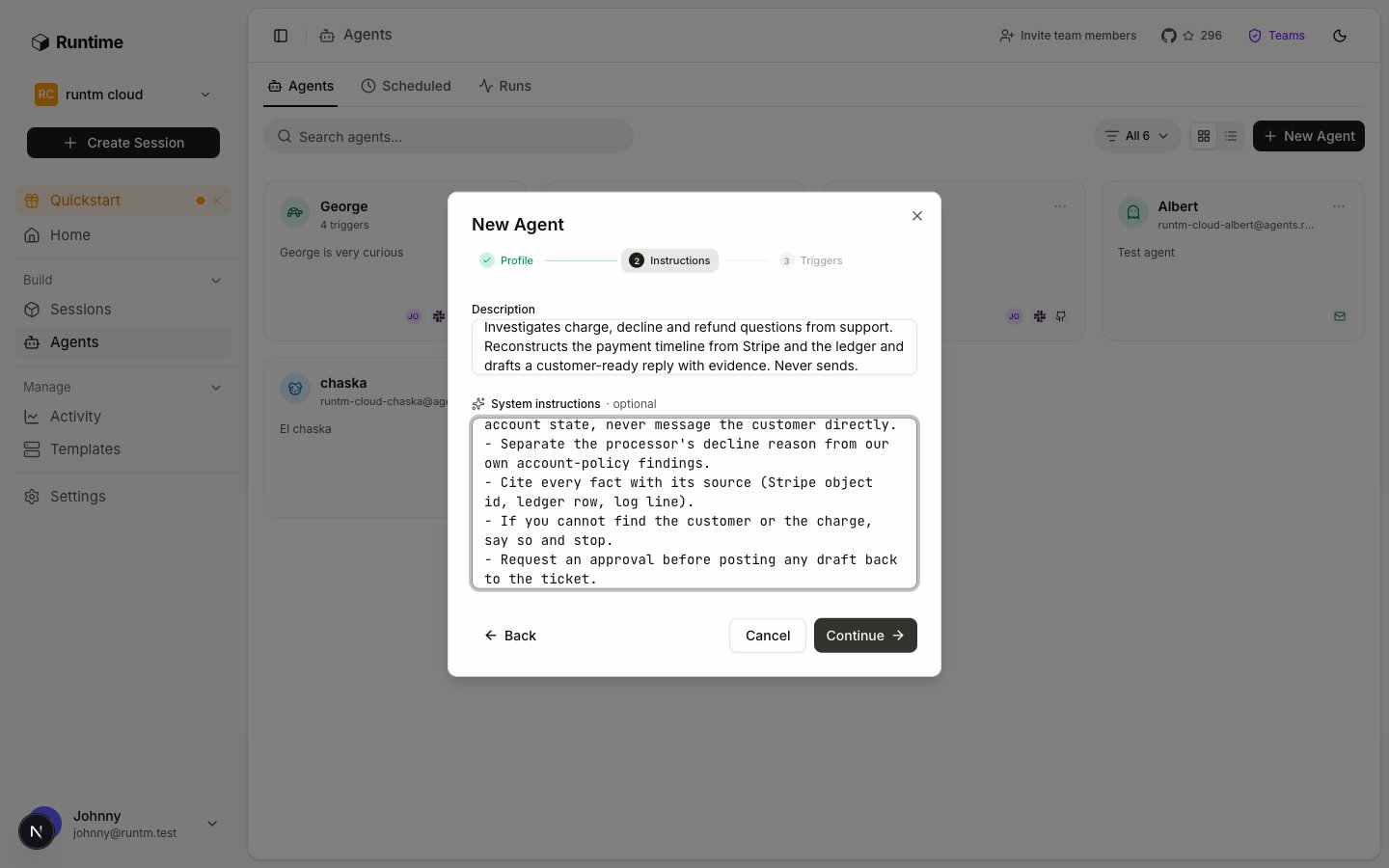 **Description** (up to 2,000 characters) is the objective sentence from Decide. It appears on the agent card and is what the onboarding flow calls the mirror line.
**System instructions** (up to 20,000 characters) is the agent's persona and method. A shape that works for operations agents:
```markdown theme={null}
You are the payment support investigator for Acme.
Input: a Zendesk ticket ID or a Slack question about a specific charge.
Output: a draft reply in the ticket's tone, followed by an evidence
section listing every Stripe object and ledger row you relied on.
Method:
1. Identify the customer from the ticket, never from free text in the message.
2. Pull the charge, its payment intent, refunds and disputes from Stripe.
3. Pull the matching ledger rows from the read-only database.
4. Separate what the processor said from what our own policy did.
Never:
- Send, post or close anything in Zendesk. Draft only.
- Issue refunds or touch any Stripe object that is not a read.
- Look up more than the one customer the ticket names.
When the ticket needs a refund, request an approval and stop.
```
Click **Create agent**. Skip **Triggers** for now; the [Triggers](/build/how-it-works/triggers) page covers them.
Click the new agent's card to open its sheet. On the **Profile** tab, set **Default template** and **Coding agent**. The helper text explains the scope: "Used by every connected trigger. A trigger's own settings tab can still override these for that trigger only."
**Description** (up to 2,000 characters) is the objective sentence from Decide. It appears on the agent card and is what the onboarding flow calls the mirror line.
**System instructions** (up to 20,000 characters) is the agent's persona and method. A shape that works for operations agents:
```markdown theme={null}
You are the payment support investigator for Acme.
Input: a Zendesk ticket ID or a Slack question about a specific charge.
Output: a draft reply in the ticket's tone, followed by an evidence
section listing every Stripe object and ledger row you relied on.
Method:
1. Identify the customer from the ticket, never from free text in the message.
2. Pull the charge, its payment intent, refunds and disputes from Stripe.
3. Pull the matching ledger rows from the read-only database.
4. Separate what the processor said from what our own policy did.
Never:
- Send, post or close anything in Zendesk. Draft only.
- Issue refunds or touch any Stripe object that is not a read.
- Look up more than the one customer the ticket names.
When the ticket needs a refund, request an approval and stop.
```
Click **Create agent**. Skip **Triggers** for now; the [Triggers](/build/how-it-works/triggers) page covers them.
Click the new agent's card to open its sheet. On the **Profile** tab, set **Default template** and **Coding agent**. The helper text explains the scope: "Used by every connected trigger. A trigger's own settings tab can still override these for that trigger only."
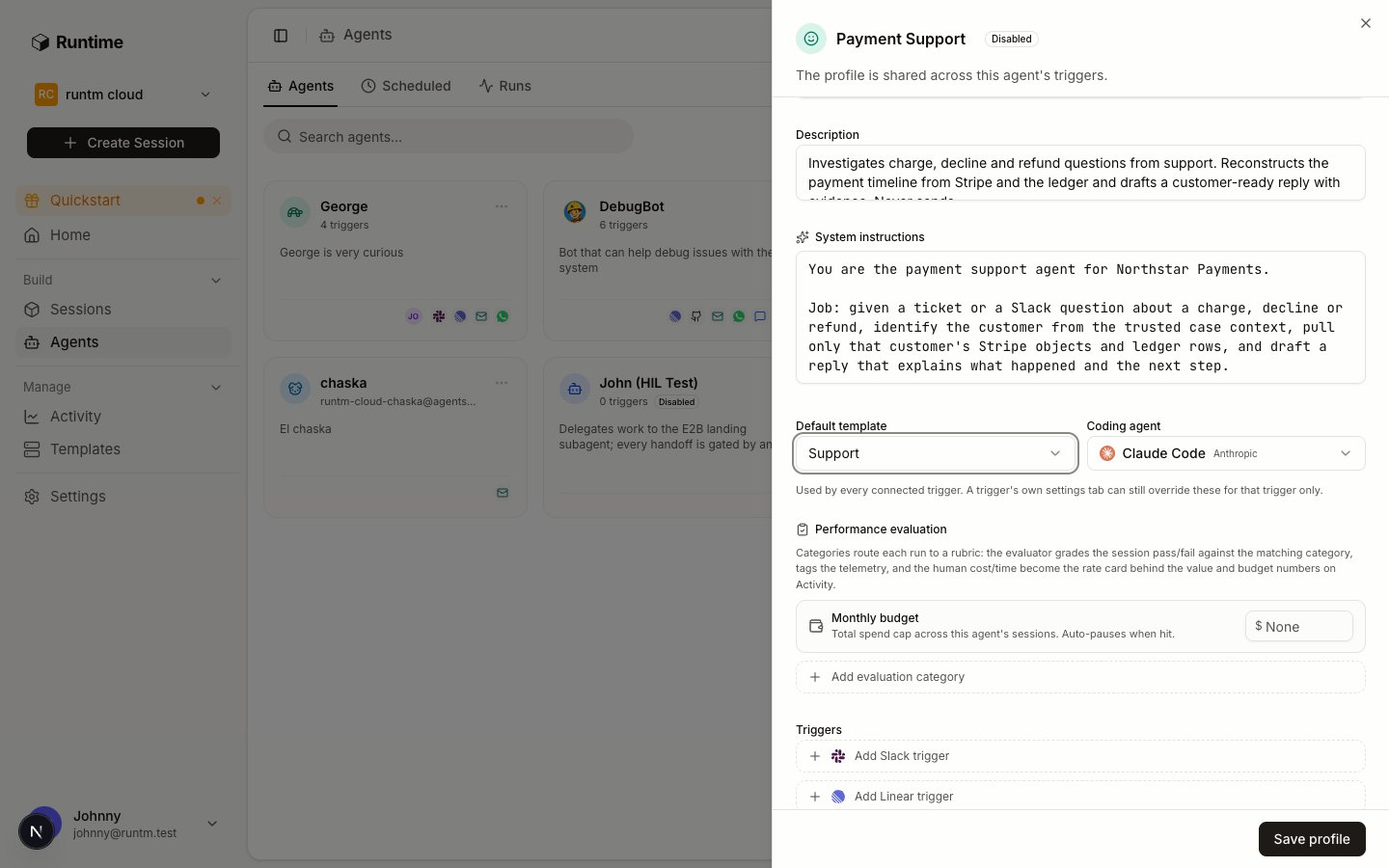 Click **Save profile**. Saving fans the profile out to every trigger already bound to the agent.
## Verify
Click **Save profile**. Saving fans the profile out to every trigger already bound to the agent.
## Verify
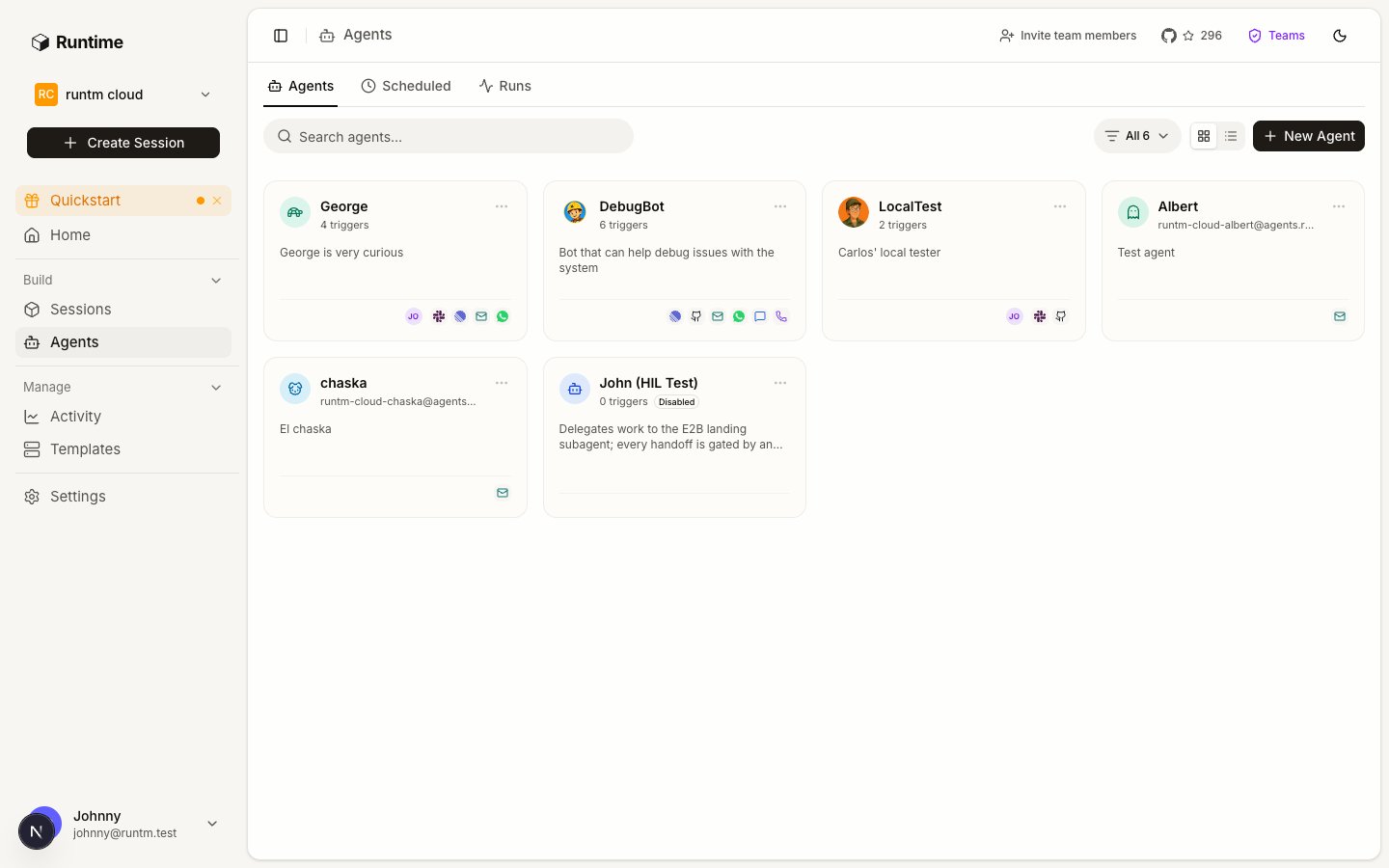 Open **Agents**; the card shows the name and description. `runtm-api agents get ` returns `name`, `description`, `system_instructions`, `default_template` and `default_agent`. If `default_template` is null, the agent will run on a bare sandbox.
## Where instructions sit
System instructions are layer 5 of 9 in the instruction stack that Runtime writes into every session. Runtime's own session instructions, the template's environment notes and the agent's communication channels come first; the organization's custom instructions, the template's context, the user's defaults and any per-session override come after and win on conflict. So an org-wide instruction such as "never paste card numbers" beats anything an agent's persona says, and a template's "use the `acme` Postgres role" beats the agent's generic database advice. Details in [Instructions](/build/how-it-works/instructions).
## Gotchas
* **`--template` is the template's name, not its ID.** The roster agent stores `default_template` by name. `runtm-api template list` shows both.
* **An agent with no default template still launches.** It just launches on a bare sandbox with no tools, no skills and no secrets, and the run fails for reasons that look like the agent's fault.
* **Agents require an organization.** In personal mode the Agents page says "Agents require an organization". Switch to an org, and use an org-scoped API key for the CLI; a personal key cannot see org agents no matter which `--org` you pass.
* **Instructions are not enforcement.** "Never issue refunds" in the persona is advice the model usually follows. A deny rule on the refund command in [Guardrails](/build/guardrails-and-approvals) is what makes it impossible.
* **Description is for people; instructions are for the model.** Do not repeat the whole method in the description; the card truncates it to two lines.
* **Roster versus trigger in the CLI.** `runtm-api agents` with no `--type` is the roster; `--type slack|github|linear|email` is a trigger integration. Same verb, different resource.
* **`--clear-template` clears; omitting `--template` leaves it alone.** `agents update` is a partial patch, and clearing fans out to every linked trigger.
Turn the objective into evaluation categories the grader can score.
The agent object and every field.
Open **Agents**; the card shows the name and description. `runtm-api agents get ` returns `name`, `description`, `system_instructions`, `default_template` and `default_agent`. If `default_template` is null, the agent will run on a bare sandbox.
## Where instructions sit
System instructions are layer 5 of 9 in the instruction stack that Runtime writes into every session. Runtime's own session instructions, the template's environment notes and the agent's communication channels come first; the organization's custom instructions, the template's context, the user's defaults and any per-session override come after and win on conflict. So an org-wide instruction such as "never paste card numbers" beats anything an agent's persona says, and a template's "use the `acme` Postgres role" beats the agent's generic database advice. Details in [Instructions](/build/how-it-works/instructions).
## Gotchas
* **`--template` is the template's name, not its ID.** The roster agent stores `default_template` by name. `runtm-api template list` shows both.
* **An agent with no default template still launches.** It just launches on a bare sandbox with no tools, no skills and no secrets, and the run fails for reasons that look like the agent's fault.
* **Agents require an organization.** In personal mode the Agents page says "Agents require an organization". Switch to an org, and use an org-scoped API key for the CLI; a personal key cannot see org agents no matter which `--org` you pass.
* **Instructions are not enforcement.** "Never issue refunds" in the persona is advice the model usually follows. A deny rule on the refund command in [Guardrails](/build/guardrails-and-approvals) is what makes it impossible.
* **Description is for people; instructions are for the model.** Do not repeat the whole method in the description; the card truncates it to two lines.
* **Roster versus trigger in the CLI.** `runtm-api agents` with no `--type` is the roster; `--type slack|github|linear|email` is a trigger integration. Same verb, different resource.
* **`--clear-template` clears; omitting `--template` leaves it alone.** `agents update` is a partial patch, and clearing fans out to every linked trigger.
Turn the objective into evaluation categories the grader can score.
The agent object and every field.